
See What the Naked Eye Can't
A home can look perfectly normal while temperature differences reveal areas that deserve a closer look. Thermal imaging is used during my standard home inspections and is also available as a standalone service for homeowners who want a focused infrared scan of their home or a specific area of concern.
What Thermal Imaging Can Help Reveal
Infrared imaging measures surface temperature differences. Those differences can sometimes point me toward conditions that deserve additional investigation.
Moisture Concerns
Evaporative cooling and temperature differences may reveal areas where moisture intrusion should be investigated further.
Insulation Deficiencies
Missing, displaced, or inconsistent insulation may create visible temperature patterns across walls and ceilings.
Electrical Hot Spots
Unusual heat at electrical components may help identify conditions that require additional evaluation.
HVAC Performance
Thermal imaging can help visualize heating and cooling patterns and areas of unexpected heat loss or gain.
What You See vs. What Thermal Imaging Reveals
To the naked eye, this room appeared completely normal. Thermal imaging revealed a noticeable temperature anomaly at the wall and ceiling transition that warranted a closer look.

Nothing immediately stands out.
During a traditional visual inspection, the wall and ceiling surfaces appear normal with no obvious indication of a concern.
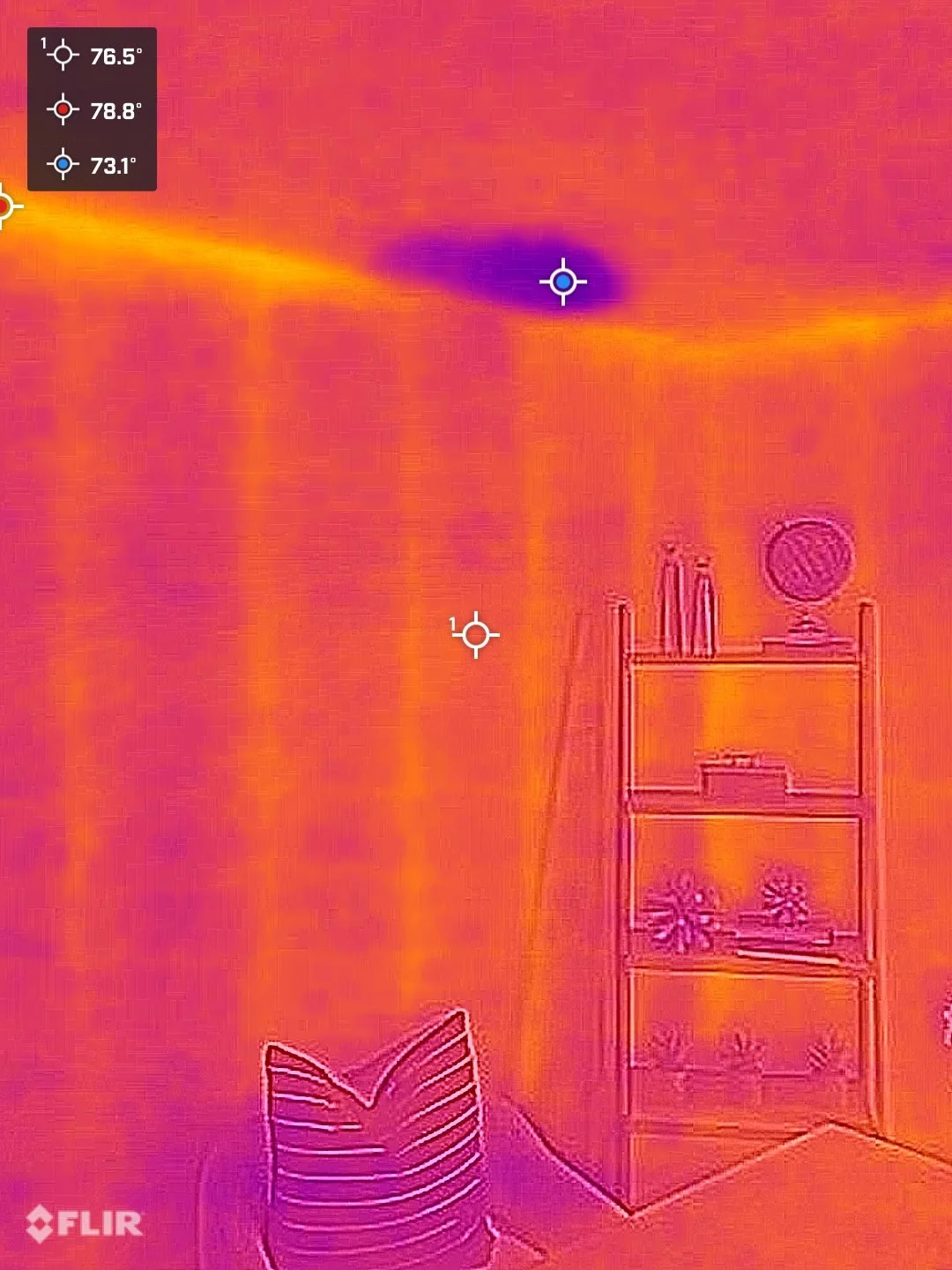
A temperature anomaly worth investigating.
The infrared image shows a cooler area along the wall and ceiling. Thermal imaging doesn't identify the cause by itself, but it tells me where additional investigation may be needed.
It gives me another layer of information that isn't always available through visual inspection alone. When I find an unusual thermal pattern, I can focus additional attention on that area.
More Than Pointing a Camera at a Wall
Thermal imaging is most useful when it's combined with experience, visual inspection, and other testing methods.
Scan
I scan accessible areas for unexpected temperature patterns and irregularities.
Investigate
When something unusual appears, I take a closer look at the area and surrounding systems.
Verify
When appropriate, thermal findings are compared with visual conditions and other inspection tools.
Report
Meaningful concerns are documented and clearly explained along with appropriate recommendations.
Thermal Imaging Isn't X-Ray Vision
Infrared cameras are powerful inspection tools, but understanding what they can and cannot do is important.
Thermal cameras measure surface temperature differences; they do not see through walls.
A thermal image does not directly prove that moisture, electrical failure, or another defect is present.
Suspected concerns should be evaluated alongside visual conditions and other inspection methods.
Weather, sunlight, indoor temperature, building materials, and other conditions can affect thermal readings.
Thermal imaging is a supplemental inspection tool — not a substitute for a complete home inspection.
Thermal Imaging Is Included
When you're scheduling a standard home inspection, thermal imaging is already part of my inspection process. You don't need to purchase a separate thermal imaging upgrade.
Need Thermal Imaging Without a Full Home Inspection?
You don't have to be buying or selling a home to take advantage of thermal imaging. Standalone thermal scans are available for homeowners who want a closer look at their home or who are trying to investigate a specific concern.
I can perform a focused infrared scan of a particular area or evaluate accessible areas throughout the home for unusual temperature patterns that may warrant further investigation.
Focused Thermal Imaging for Your Home
Have a room that never feels right? Suspect a leak but can't see where it's coming from? Concerned about missing insulation or unusual heat patterns?
A standalone thermal scan gives you access to infrared imaging without scheduling a complete home inspection.
Thermal imaging identifies surface temperature differences. Additional evaluation or specialized testing may be recommended depending on what is observed.
Thermal Imaging FAQ
A few things homeowners and buyers commonly want to know about infrared inspections.
Is thermal imaging included with my home inspection?
Can I schedule thermal imaging without a home inspection?
Can thermal imaging find water leaks?
Can a thermal camera see through walls?
Can thermal imaging detect mold?
Does every hidden problem show up on thermal imaging?
Will thermal images be included in my inspection report?
A Better Look at Your Home
Whether you're buying a home or investigating a concern in the home you already own, thermal imaging can provide another layer of useful information that isn't always visible to the naked eye.